Do you know your next customer may not search for you on Google first?
They may ask ChatGPT. They may compare options on Perplexity. They may use Gemini to understand which business, agency, tool, or service provider is best for them. And here is the real question: when they ask those AI tools, will your business appear in the answer?
Ohh really? Yes, this is already happening.
People are no longer using search in the old way. Earlier, someone would type “best SEO agency in India” or “digital marketing company near me” into Google. Now, many users ask full questions like, “Which agency can help my startup grow through SEO and AI visibility?” or “How can I make my business show up on ChatGPT?” AI tools then give direct answers rather than showing a list of links.
This is where AI visibility becomes important. If your business is not clearly visible, trusted, and explained online, AI tools may not include you in their answers. That means you may lose potential leads before they even visit your website.
What Is AI Visibility?
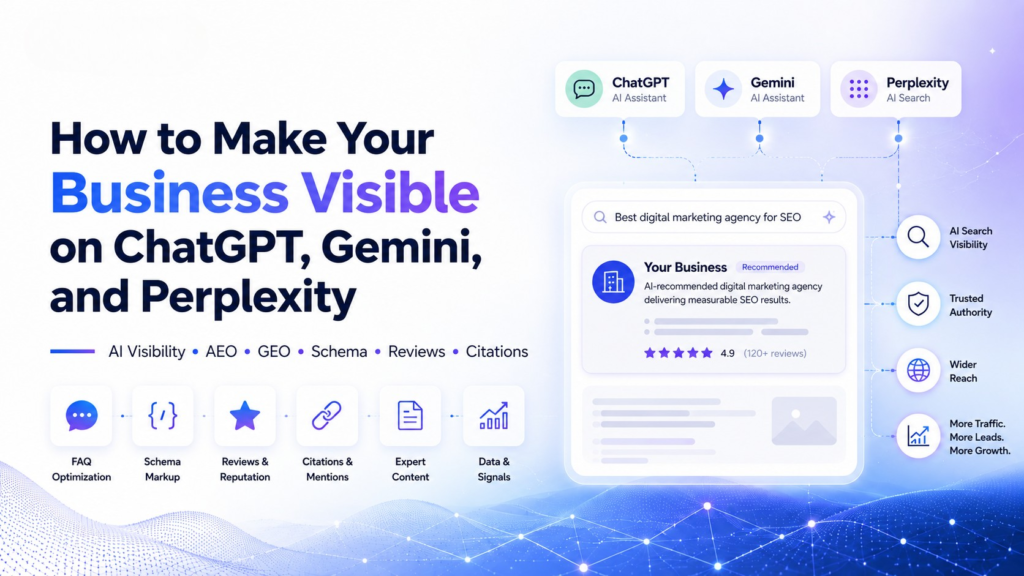
AI visibility means how easily platforms like ChatGPT, Gemini, Perplexity, and other AI search tools can understand, trust, and mention your business in their answers. It is not only about ranking on Google anymore. It is about becoming a clear and reliable source across the web.
Think of it like this. SEO helps a website rank. AEO helps your content answer user questions. GEO helps your brand appear in AI-generated answers. Together, they create a stronger online presence for your business.
AEO means Answer Engine Optimization. It focuses on creating content that answers real questions in a simple and useful way. GEO means Generative Engine Optimization. It focuses on improving your brand presence across AI tools that generate answers from online sources.
So, if SEO is about being found, AEO is about being understood, and GEO is about being recommended.
Why Businesses Should Care About ChatGPT, Gemini, and Perplexity
Let’s say a business owner wants to hire a digital marketing agency. Instead of opening 10 websites, they ask an AI tool, “Which agency can help with SEO, content marketing, and AI visibility?” The AI tool may suggest a few names based on available information, reviews, online mentions, articles, and trusted sources.
If your business has strong content, good reviews, proper schema, and mentions on websites, you have a better chance of being included. But if your website has thin content, unclear service pages, no FAQs, no reviews, and no online authority, AI tools may ignore your business.
This does not mean Google SEO is dead. Not at all. SEO is still very important. But search behaviour is changing. People want quick answers. They want trusted suggestions. They want clear comparisons. AI tools are becoming part of that decision-making journey.
For businesses, this means one thing: your online presence should be built for both search engines and AI answer engines.
Start With Clear Website Content
Your website is still the foundation of your AI visibility. If your website does not clearly explain what you do, who you help, and why people should trust you, AI tools will also struggle to understand your business.
Every important page on your website should clearly explain your services, expertise, audience, and value. Avoid vague lines like “we help brands grow digitally” without explaining how. Be specific. Mention your services, industries, locations, process, results, and expertise.
For example, instead of only saying, “We provide digital marketing services,” you can say, “We help businesses improve visibility through SEO, AEO, GEO, content marketing, technical SEO, and website optimization.”
That is much clearer. It gives both users and AI tools better context.
Also, write in a natural tone. AI tools are trained to understand helpful human-like content. If your content is full of keyword stuffing, generic lines, and repeated phrases, it may not perform well. Your content should sound like an expert explaining something clearly to a real person.
Create Content That Answers Real Questions
Do you know what AI tools love? Clear answers.
Many businesses still write blogs only for keywords. They pick a keyword, add it in the title, repeat it several times, and hope the page ranks. But AI visibility needs more than that. Your content should answer the actual questions your customers are asking.
For example, if you offer SEO services, do not only write “Best SEO Services in India.” Create helpful topics like “How Long Does SEO Take to Show Results?”, “What Should You Check Before Hiring an SEO Agency?” “Can SEO Help Small Businesses Get More Leads?”, and “How to Make Your Business Visible on ChatGPT and Perplexity?”
These topics are useful because they match real user intent. People ask similar questions of AI tools. If your website already answers those questions clearly, your content becomes more useful for AI platforms.
The best content is not always the longest content. It is the content that gives the right answer in the right way. Use simple language, short sections, examples, and practical advice. Make the reader feel, “Okay, this actually helped me.”
Add FAQs to Important Pages
FAQs are very powerful for AI visibility. They help users find quick answers and help search engines and AI tools understand your content.
Every important page on your website should have a helpful FAQ section. Your service pages, blog posts, landing pages, and industry pages can all include FAQs. But the questions should be natural. Do not add random FAQs only for SEO.
For example, on an SEO service page, you can include questions like: “How long does SEO take?” “What is included in SEO services?” “Can SEO help my local business?” “Do you also help with AI visibility?”, and “What is the difference between SEO and AEO?”
The answers should be clear and direct. You do not need to write a full essay for every FAQ. Around 50 to 80 words is enough in most cases. The goal is to answer the question properly without making the reader work too hard.
Here is a simple example. “Can my business appear on ChatGPT?” Yes, your business can improve its chances of appearing in ChatGPT-style answers by creating helpful content, adding FAQs, using schema, collecting reviews, building citations, and keeping brand information consistent across the web.
Simple, right? That is the kind of answer users and AI tools both understand.
Use Schema Markup for Better Understanding
Schema sounds technical, but it is not as scary as it looks. Schema markup is a type of structured data that helps search engines understand a website.
You can use schema to explain that a page is an article, a service, an FAQ, a local business, a product, a review, or an organization. This gives machines extra clarity about your content.
For AI visibility, a schema is useful because it makes your website information more structured. It does not guarantee that your business will appear in ChatGPT, Gemini, or Perplexity. But it helps your content become cleaner and easier to understand.
Some useful schema types for businesses include Organization schema, Local Business schema, FAQ schema, Article schema, Service schema, Review schema, Author schema, and Breadcrumb schema.
If your website is on WordPress, schema can be added through SEO plugins or custom code. But make sure it is done correctly. A wrong or fake schema can create trust issues. Add only the information that is true and relevant.
Build Reviews and Trust Signals
Ohh, this one is important.
Reviews are not only for customers. They also act as trust signals across the web. When your business has strong reviews on Google, Clutch, GoodFirms, Trustpilot, G2, or other relevant platforms, it helps show that real people trust your service.
AI tools review different signals across the web to understand whether a brand is reliable, relevant, and worth mentioning. If your business has positive reviews, testimonials, case studies, and client feedback, it gives more confidence.
But here is the key: specific reviews are better than generic reviews.
A review that says “Good service” is fine, but a review that says “SearchCraft helped us improve our SEO visibility and content strategy” is much more useful. It gives context about what you actually do.
So, encourage happy clients to leave honest reviews. Ask them to mention the service they used, the problem you solved, and the result they experienced. Also, showcase selected testimonials on your website with proper details.
Trust is one of the biggest parts of AI visibility. A trusted online presence helps both people and AI tools see your brand as credible and reliable.
Get Listed on Trusted Websites and Directories
Your website matters, but AI tools also look at other online sources to understand your business. This is why brand mentions, directory listings, and citations are important.
A citation is an online mention of your business name, website, address, phone number, or profile. It can appear on directories, business listings, industry websites, social platforms, review websites, or media websites.
For example, a marketing agency can create strong profiles on platforms like Google Business Profile, LinkedIn, Clutch, GoodFirms, DesignRush, Sortlist, Crunchbase, and other relevant directories. A local business can focus on local directories, maps, and location-based listings.
But do not create listings everywhere just for the sake of it. Quality matters more than quantity. A mention on a trusted industry website is more valuable than 50 random, low-quality directory links.
Also, keep your business information consistent. Your business name, website URL, phone number, email, location, and service description should be the same across all platforms. If every platform says something different, it creates confusion.
And AI tools do not like confusion.
Publish Expert Content, Not Generic Blogs
This is where many businesses make a mistake. Many blogs sound the same because they repeat common advice without adding real examples, experience, or useful insights.
If you want AI visibility, your content should show expertise. It should include original insights, real examples, client learnings, case studies, industry observations, and practical tips.
For example, instead of writing a basic topic like “Importance of SEO for Business,” write something stronger like “How AI Search Is Changing Lead Generation for Service Businesses” or “SEO vs AEO vs GEO: What Should Businesses Focus on First?”
These topics feel more current, more useful, and more interesting. They also show that your business understands where search is going.
You can also add expert quotes, founder insights, team experience, process breakdowns, and results from your work. This makes the content more trustworthy and less robotic.
Remember, AI tools do not need another boring article. They need useful information that helps answer real questions.
Keep Your Brand Active on LinkedIn and Other Platforms
Your website is your main base, but social platforms can also support your AI visibility. LinkedIn is especially useful for B2B businesses, service providers, consultants, founders, and agencies.
When your company and team members regularly share useful insights, it creates more brand signals. You can talk about SEO updates, AI visibility, customer questions, digital marketing trends, and practical tips.
You can also repurpose your blogs into LinkedIn posts, carousels, short videos, newsletters, and case study posts. This helps your content reach more people and creates more online context around your brand.
For example, after publishing this blog, SearchCraft can also create a LinkedIn post titled “Your Next Customer May Ask ChatGPT Before Visiting Google.” That kind of hook can make people stop and read.
Do you see the point? One blog should not stay only as one blog. It should become multiple pieces of content across different platforms.
Make Your Website Technically Clean
AI visibility also depends on technical SEO. If your website has crawl issues, slow pages, broken links, poor structure, or blocked pages, your content may not get discovered properly.
Make sure your important pages are indexable. Check your sitemap, robots.txt file, canonical tags, internal links, headings, page speed, mobile layout, and schema validation. These things may look small, but they affect how search engines and AI-connected systems understand your website.
Also, use clear headings. Add proper image alt text. Interlink blogs and service pages. Keep your website structure simple.
A messy website makes it harder for both users and machines. A clean website improves trust, readability, and discoverability.
Create Content for Comparison and Decision-Making
People often use AI tools when they want help making a decision. They ask questions like “Which agency is best for small businesses?”, “What is the difference between SEO and paid ads?”, or “Should I invest in SEO or AEO?”
This creates a big content opportunity.
You can publish comparison-style and decision-support content. For example, “SEO vs AEO vs GEO: What Is the Difference?”, “How to Choose the Right Digital Marketing Agency”, “Best AI Marketing Tools for Small Businesses”, or “What to Ask Before Hiring an SEO Agency.”
This type of content works well because it helps users make smarter decisions. It also gives AI tools more context about your expertise.
But keep the content honest. Do not turn every comparison into a sales pitch. Help the reader first. Promote your service naturally later.
Simple AI Visibility Checklist for Your Business
Before asking how to rank on ChatGPT, check whether your online foundation is ready.
Your website should have clear service pages, blogs, FAQs, schema markup, reviews, testimonials, case studies, directory listings, consistent business information, internal links, and expert content. Your brand should also be active on platforms where your target audience spends time.
If most of these things are missing, start there. AI visibility is not one small trick. It is a complete trust-building process.
The more clearly your business is explained across the web, the better your chances of being found, understood, and recommended.
Final Thoughts
AI search is changing how people discover businesses. Your customers may still use Google, but they may also ask ChatGPT, Gemini, Perplexity, or other AI tools before making a decision.
That means your business needs to be ready for both traditional search and AI-powered discovery.
You need strong SEO. You need clear answers. You need expert content. You need FAQs, schema, reviews, citations, and consistent brand information. Most importantly, you need to make your business easy to understand.
Because AI tools cannot recommend what they cannot understand.
At SearchCraft, we help businesses improve their visibility across search engines and AI platforms through SEO, AEO, GEO, content strategy, and technical optimization. If your customers are already asking questions about AI tools, your business should be part of those answers.
The future of search is not only about ranking. It is about becoming the answer.