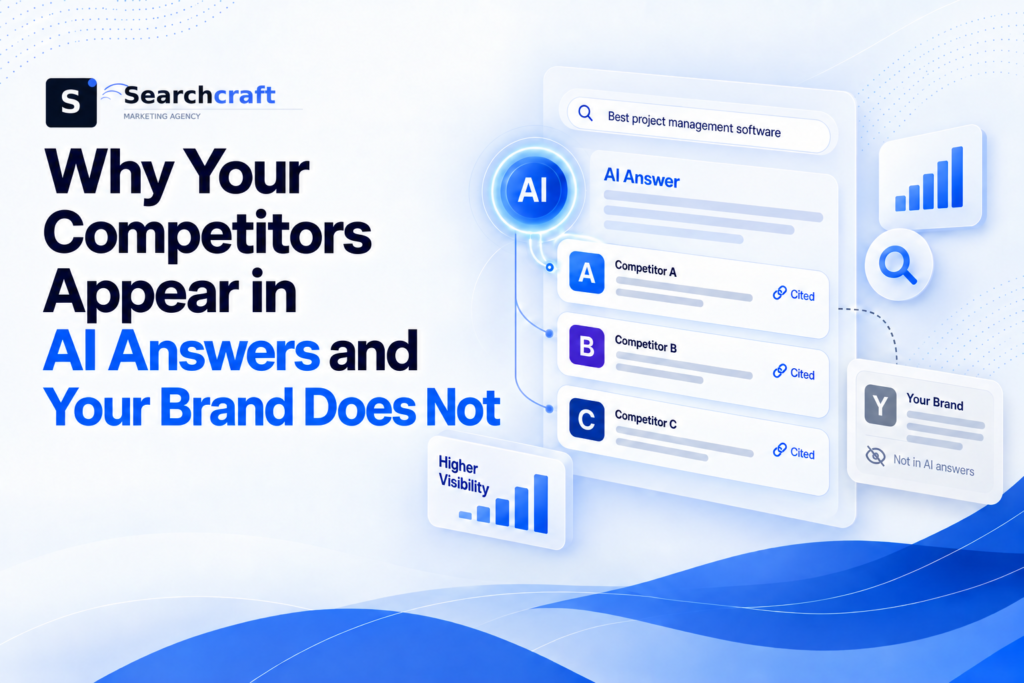
You type a prompt into ChatGPT, Perplexity, or Google AI Overviews to see how your product or service is positioned in the market. Your main competitor shows up right away. Their name is highlighted, their features are neatly summarized, and they are recommended as a top choice.
You type another query, and another. Still, your brand is nowhere to be found.
Meanwhile, your traditional website traffic might be holding steady, and your standard SEO keyword rankings look fine. So what is happening? Why are AI engines completely ignoring your brand while treating your competitors like industry royalty?
The short answer is that AI search does not care about your keyword rankings; it cares about extraction, structure, and verification.
1. You Are Writing for Human Attention; They Are Writing for Machine Extraction
Traditional content marketing taught us to tell a story. We write long introductions, build emotional hooks, and save the core answer for halfway down the page to keep users scrolling.
Large Language Models (LLMs) hate this approach. When an AI model processes a prompt, it looks for high fact density and instant answers.
- How your competitors write: They use an inverted pyramid structure. The direct answer sits in the first 40 words, followed by clean bullet points, structured comparison tables, and clear headings formatted as actual questions.
- How your brand writes: You bury your value proposition behind three paragraphs of corporate fluff and creative branding.
When the AI tries to extract a quick snippet to answer a user’s question, your competitor’s page hands it a ready-made, clean paragraph. Your page makes the AI work too hard, so it skips you entirely.
2. You Blocked the Bots (Or Made It Hard for Them to Read)
Believe it or not, many brands are invisible in AI search simply because their technical setup locks the doors to AI crawlers.
Check your robots.txt file and server configurations. If you have aggressively blocked crawlers like GPTBot, ClaudeBot, or PerplexityBot out of generalized data privacy fears, you have effectively opted your brand out of the AI economy.
Furthermore, if your website relies heavily on client-side JavaScript to render key product details, prices, or specifications, an AI scraper might see a blank page or a jumbled mess. Your competitors win because their site architecture is server-rendered, open, and structured with proper schema markup (like Organization, Product, and FAQ schema) that acts like a neon sign for LLMs.
3. They Own the “Consensus Web”
AI models are inherently risk-averse. They are programmed to hallucinate less by relying on cross-source consensus. If an AI engine is going to recommend a product, it looks for validation across multiple independent parts of the internet—review sites, Reddit threads, industry forums, and niche publications.
Your competitors understand that their digital footprint extends far beyond their homepage. They actively seed their brand name into community discussions, software aggregators, and expert roundups.
When an AI model cross-references your competitor across ten different independent sources, its confidence score spikes. If your brand only talks about itself on its own website, the AI views you as an isolated island with 0 corroborating proof.
4. They Have Clear “Entity Authority”
To an AI, a keyword is just a word, but an entity is a recognized “thing”—a company, a person, a product, or a concept with defined relationships.
Your competitors have built strong entity profiles. When an AI processes data about them, it clearly understands:
- What category they belong to.
- Who their target audience is.
- What specific features or integrations they offer.
If your website uses vague pronouns (“our software,” “our platform,” “we help businesses”) instead of explicitly naming your product alongside your category and use cases, the AI’s vector embeddings fail to connect your brand to the user’s intent. You might know what you sell, but the model cannot map your brand identity cleanly.
Frequently Asked Questions
Does traditional SEO still matter for AI search visibility?
Yes, but it is no longer enough on its own. High traditional search rankings help AI crawlers find your pages faster, but citation in an AI answer depends entirely on content structure, clarity, and machine-readability.
How can I check if my brand is appearing in AI answers?
You can perform manual prompt testing across platforms like ChatGPT, Perplexity, Gemini, and Microsoft Copilot. For scale, specialized Generative Engine Optimization (GEO) tracking tools can monitor your brand mentions and citation share over time.
How long does it take to fix my AI visibility?
Technical and structural fixes (such as rewriting page intros, adding FAQ schema, and updating heading tags) can yield improvements in AI Overviews and answer engines within 4 to 8 weeks.
Should I block AI scrapers to protect my intellectual property?
Blocking crawlers prevents your content from being used to train models, but it also completely removes your chances of being cited as a source when prospective buyers ask buying-intent questions. Most commercial brands benefit far more from visibility than they lose from extraction.
Shifting From Keywords to Citations
The shift from traditional search engines to generative AI is the biggest change in digital marketing in decades. Winning this space requires moving away from simply optimizing for a keyword to trust, clarity, and extraction.