If you run a business or manage a digital marketing team today, you have likely noticed a massive shift in how people find products and services. Traditional keyword rankings on Google are no longer the only game in town.
Instead, potential customers are typing complex conversational queries into ChatGPT, Google AI Overviews, Perplexity, and Claude. They expect direct, synthesized answers rather than a page of ten blue links.
This has given birth to a brand-new discipline: Generative Engine Optimization (GEO) or Answer Engine Optimization (AEO). The core challenge is simple: Traditional SEO tools cannot track what AI models say about your brand.
To see whether you are winning or losing in AI answers, you need specialized software. Let’s look at the best AI search visibility tools available to track, measure, and improve your generative footprint.
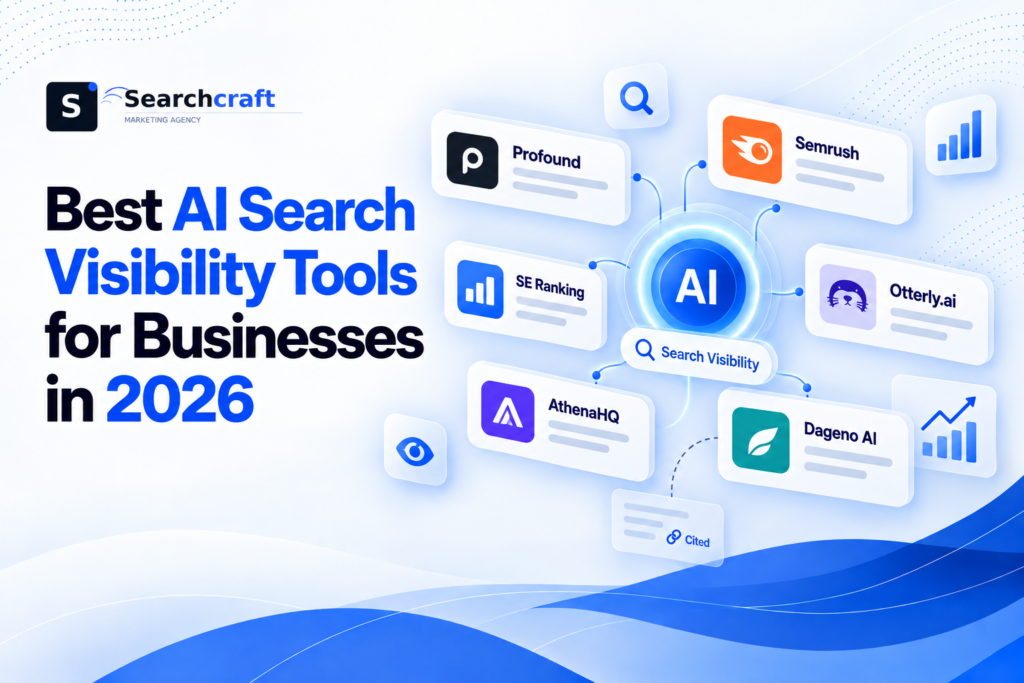
1. Profound: Best for Enterprise Prompt Intelligence
If you manage a large brand with massive product lines and deep market competition, Profound is built for enterprise-scale intelligence.
Profound treats AI search as a critical, distinct channel. Instead of just tracking basic keyword positions, it maps out conversational prompt-demand research, multi-engine visibility, and precise citation sources.
- Why it stands out: It handles complex enterprise tracking by using advanced prompt “fan-out” techniques (capturing thousands of variations of how buyers actually talk to AI assistants).
- Best suited for: Enterprise marketing, analytics, and brand safety teams that need rigorous, data-driven reporting to justify executive strategy.
2. Semrush AI Visibility Toolkit & SE Ranking: Best for SEO Ecosystems
Many marketing teams prefer to add AI visibility data to their existing SEO tools and workflows rather than switch to a completely new platform. Major players have responded directly to this need.
- Semrush AI Visibility Toolkit: Built natively into the broader Semrush suite, this tool lets you monitor Google AI Overviews alongside chat-based engine visibility, tracking whether your domain is cited when target buyer queries trigger generative summaries.
- SE Ranking (with AI Search Add-on): SE Ranking shows how brands appear in Google AI Overviews and selected AI assistants. Teams can compare this data with their traditional keyword rankings.
- Why they stand out: Zero learning curve for teams already familiar with traditional search platforms. You can view your classic keyword rankings and AI citation data.
- Best suited for: In-house marketing teams and agencies that want an all-in-one platform (without juggling separate standalone dashboards).
3. Otterly.ai: Best for Getting Started on a Budget
If you are a smaller business or an agency testing the waters of AI visibility without an enterprise budget, Otterly.ai is widely recognized as one of the most accessible entry points on the market.
- Why it stands out: It provides affordable plans with essential AI visibility tracking features. You can quickly track multi-engine brand mentions, check sentiment, and see basic competitor comparisons.
- Best suited for: Small-to-medium businesses and lean marketing teams that need a clear, budget-friendly baseline reading of their AI search health.
4. AthenaHQ & Dageno AI: Best for Actionable Optimization
Monitoring your lack of visibility is helpful, but fixing it is what actually drives revenue. Platforms like AthenaHQ and Dageno AI focus heavily on bridging the gap between passive analytics and active content workflows.
- AthenaHQ: Designed as a collaborative workspace for content, SEO, and PR teams, it turns visibility data into prioritized optimization tasks.
- Dageno AI: Connects prompt tracking and competitor share-of-voice directly to content creation workflows, helping teams figure out precisely which web pages need structural rewrites to win AI citations.
- Why they stand out: They focus on actionability, telling you not just that you are losing to a competitor, but what content changes you need to make to steal that citation slot.
- Best suited for: Growth-stage companies and content operations teams ready to actively optimize their web properties for machine extraction.
Frequently Asked Questions
What is the difference between a traditional SEO tool and a GEO tool?
Traditional SEO tools track keyword positions on a static search engine results page (SERP). GEO tools monitor probabilistic, conversational AI models (like ChatGPT and Perplexity) to see if your brand is mentioned, cited, or recommended in synthesized answers.
Do AI search visibility tools track real user queries?
Yes. Top-tier tools utilize large prompt databases derived from real-world search behavior, conversational logs, and “People Also Ask” variations to simulate how prospective buyers actually question AI assistants.
How often do AI search visibility metrics change?
Unlike traditional rankings, AI-generated answers and citations can change frequently because of model updates, search index changes, and new competitor content. Most platforms offer daily or weekly tracking updates to capture these shifts.
Can I track my competitors using these platforms?
Absolutely. Competitor benchmarking is a core feature of almost every major GEO tool, allowing you to see their “share of voice” in AI answers compared to your own.
Choosing the Right Tool for Your Growth Stage
As generative search grows, businesses should focus on whether AI platforms mention their brand (instead of relying only on traditional visibility metrics). Whether you choose an enterprise suite like Profound, an integrated package like Semrush, or an accessible starter tool like Otterly.ai, getting visibility into your AI footprint is the first step toward dominating future search channels.